Support / Guides / 5 Monsoon Water Checks for Restaurants and Hotels in Myanmar
The rain does not warn you during service hour.
5 Monsoon Water Checks for Restaurants and Hotels in Myanmar
For: Restaurant owners, hotel operators and facility managers in Myanmar
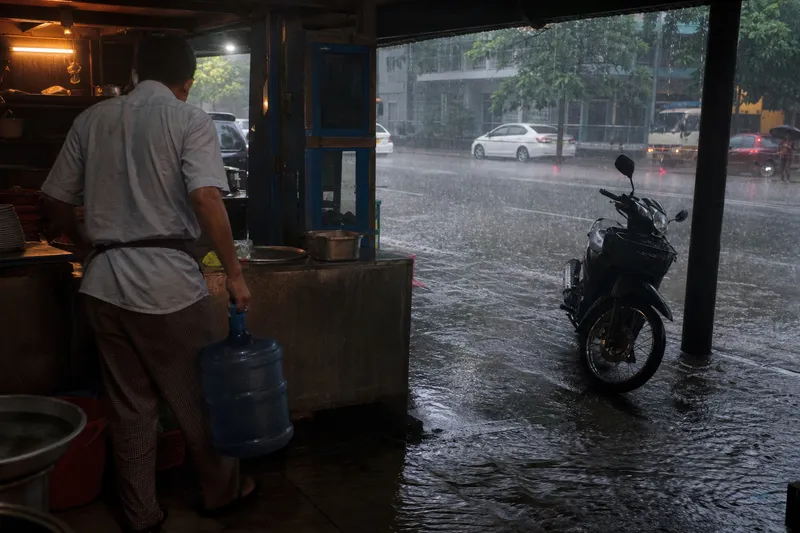
Restaurants and hotels in Myanmar should review five monsoon-season checkpoints: how the incoming water source is behaving, whether sediment or smell changes appear during service hours, whether peak guest and kitchen demand exposes a capacity gap, whether filters and sanitation steps are current, and who to contact before a system fails mid-service.
That is the checklist. Below is what each check means in a real kitchen, and when a checklist should become a site review.
*Last reviewed: 4 August 2026.*
Why monsoon season changes water risk in Myanmar
Monsoon flooding in Myanmar can contaminate water sources — that is established national WASH context, documented by UNICEF Myanmar's WASH programme, not a seller's scare story. UNICEF's July 2026 reporting from Amarapura illustrates the pattern concretely: in low-lying areas, floodwater can enter wells repeatedly, disrupting household water access.
Seasonal outlook matters for planning too. The 26th ASEAN Climate Outlook Forum predicted above-normal rainfall over coastal and southern Myanmar for the 2026 Southwest Monsoon (ASEAN Specialised Meteorological Centre). An outlook is a probability statement about a region, not a prediction about your building — but it is a reasonable argument for checking your water arrangements early rather than in the middle of a storm week.
There is also a health signal worth date-stamping honestly: WHO regional reporting recorded an increase in acute watery diarrhoea and cholera in Myanmar in May 2026 (WHO Weekly Epidemiological Record, WER101-26). Treat that as a reason for operational care, not as a diagnosis and not as a claim about any particular property.
For a hospitality business, the practical exposure is not abstract. It is guest confidence at the refill station, kitchen prep that cannot pause, staff drinking water, and the specific hour when both the dining room and the kitchen want water at once.
Check 1: What changed in your incoming water source this week?
Start with the supply itself, before touching any equipment.
- Has municipal supply become intermittent, or changed pressure?
- If you use a borehole, has yield, colour or smell shifted after heavy rain?
- If you rely on tanker delivery, has the schedule or the supplier's source changed?
- Is there standing water, flooding or drainage backup anywhere near your source, wellhead or tank inlet?
- Has anything upstream changed — construction, road work, a neighbour's new pump?
Write down what changed and when. A dated note beats memory, especially when three staff each remember a different week.
The single most common monsoon pattern we hear from Yangon operators is not dramatic. It is "the water is fine most days, but after a heavy night it tastes different for a day or two." That is a source-behaviour observation, and it is exactly the kind of detail that makes a later review useful.
Check 2: Are sediment, colour, smell or taste changes appearing during service hours?
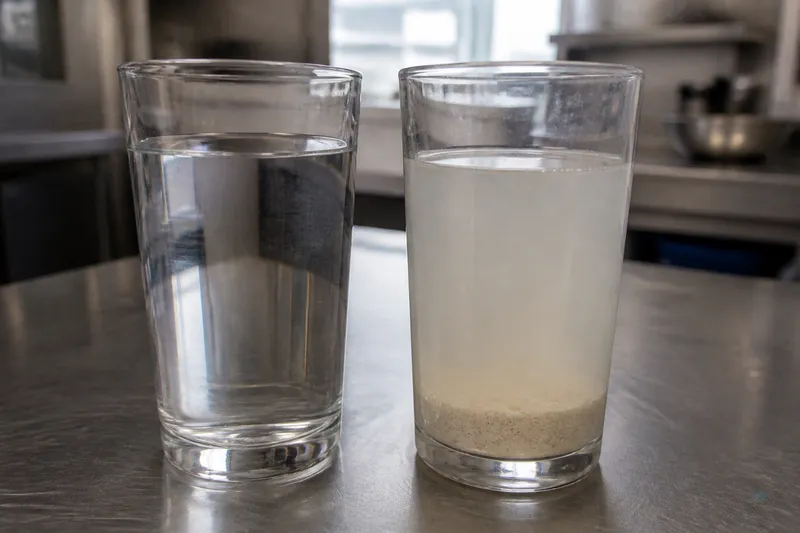
Sensory checks are free, and staff notice things before instruments do.
- Cloudiness or fine sediment settling in a glass left standing
- A colour tint, especially after heavy rain
- Earthy, musty, metallic or chlorine-strong smell
- Taste complaints from guests or staff — logged, not dismissed
- Visible sediment in strainers, kettle bases or ice machines
Make it a routine: one clear glass, same tap, same time each day, ten seconds of attention. Log the date, tap, and what was observed.
Two cautions, both important. First, sensory checks tell you *something changed* — they do not tell you what is in the water, and this page is not a substitute for laboratory testing. Second, do not let a taste complaint automatically become an equipment purchase. Sometimes the source changed, sometimes a filter is overdue, and sometimes a pipe or tank is the real story. Home-scale version of the same trap: rainy season taste and smell changes.
Check 3: Does peak guest or kitchen demand expose a capacity gap?
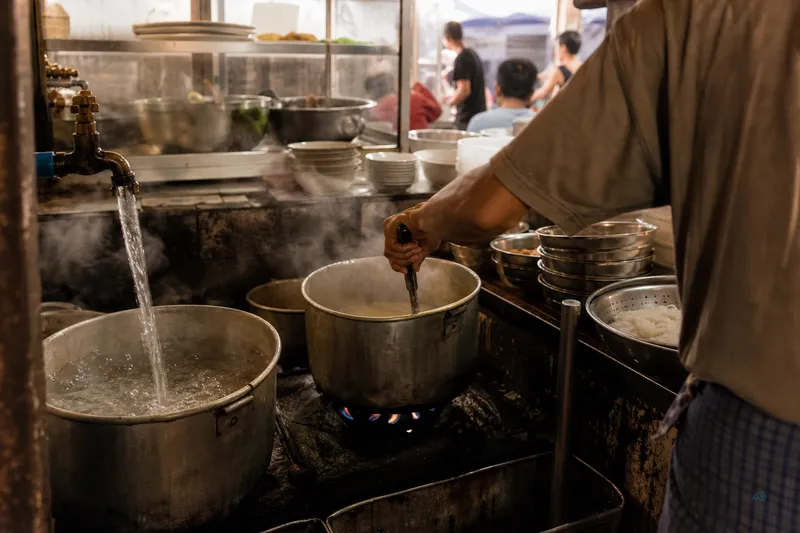
Monsoon weeks change demand shape, not just water quality. Rain pushes guests indoors, delays deliveries, and lengthens service.
- What is your worst realistic hour — not your daily average?
- Does treated-water output keep up during that hour, or do you run down a tank and hope?
- How much storage do you actually hold, and how fast does it refill?
- Do kitchen prep, guest drinking water, tea and ice compete for the same supply at the same time?
- What happens on a power interruption during that hour?
If your honest answer is "we usually manage," monsoon season is the wrong time to test that sentence. Sizing by seats or room count instead of peak-hour behaviour is the classic hospitality mistake — see hotel and restaurant RO sized by peak service and commercial RO for the lunch rush.
We are deliberately not naming a system or a capacity for you here. Which class fits depends on your source water, your peak hour and your site — that requires a review, not a web page.
Check 4: Are filters, housings, pretreatment and sanitation steps current?
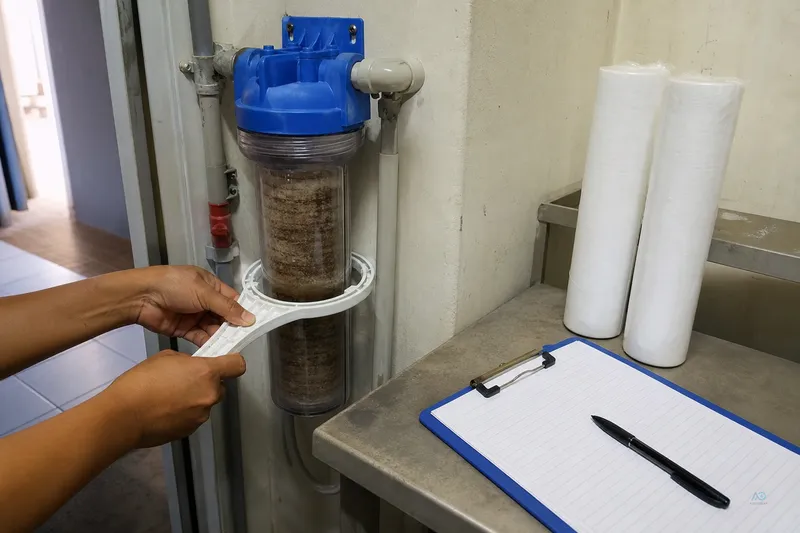
Monsoon season is when a deferred service becomes visible.
- When was each filter or cartridge last changed, and who changed it?
- Is there a written maintenance log, or is it in one person's head?
- Are housings, seals and fittings free of leaks and biofilm?
- Is pretreatment keeping up, or is a higher sediment load already showing downstream?
- Are storage tanks cleaned on a schedule, with covers and inlets sealed against ingress?
- Are refill points, dispensers and ice machines cleaned on a routine?
- Do you hold spares on site, or does a failure mean waiting?
Higher sediment load in the wet season shortens consumable life. Nothing has gone wrong when a filter needs changing earlier than usual in a storm month — but pretending the interval never changes is how a kitchen ends up with no treated water on a busy Saturday.
Consumables and spares path: spare parts · reorder discipline in Yangon · what to ask before a filter change.
Check 5: Do you know who to contact before the system fails during service?
The last check is not technical. It is a phone number and a named person.
- Who does a staff member call at 7pm on a Saturday when output drops?
- Who is authorised to approve an urgent service visit or a spare part?
- Is there a written fallback for a supply interruption — bottled stock, a second tank, a reduced-service plan?
- Does your team know the difference between "call the supplier" and "shut something off first"?
- Is that written on the wall where the equipment is, not in a chat thread from last year?
Operators who have this written down lose an hour. Operators who do not lose a service.
Viber 09668896889 · Request a review or quote · Facebook message · Insein showroom
When to escalate from checklist to site review
Move from self-checks to a proper review when any of these are true:
- Source behaviour changed and has not returned to normal
- Sediment, colour or smell changes are recurring rather than one-off
- You ran out of treated water during a service hour, even once
- Consumable life has dropped noticeably this season
- Nobody can say when equipment was last serviced
- You are planning to expand covers, rooms or opening hours
- Guests or staff have raised repeated complaints
A review means we look at your water source information, your real peak demand, your existing setup and your site conditions — and then discuss options. Not the other way around.
What a review is not: a promise that a specific product fits your property, a water-quality guarantee, or a laboratory result. Equipment class talk comes after your source and demand are on paper. Browse only after that: RO systems · UV sterilizers.
What to send so the first conversation is useful
Send these on Viber and the review starts properly:
- Township and property type — restaurant, hotel, guesthouse, or mixed
- Water source: municipal, borehole, tanker, or a combination
- What changed this monsoon season, and when you first noticed
- Rough peak-hour demand and how much storage you hold
- What treatment equipment is installed now, and its last service date
- Photos of the equipment area, tank and any visible sediment
- Whether you want a review, a quote, or a showroom conversation
Incomplete is fine. Guessed numbers presented as facts are worse than blanks.
Limitations of this page
- This is operational guidance for hospitality operators. It is not a substitute for laboratory water testing.
- Health references are informational context from cited public-health reporting, dated as published. Nothing here is a medical opinion, diagnosis or treatment claim.
- We make no claim about the water quality at any specific property, and no guarantee that any product suits your site before a review.
- Climate outlooks describe regional probability, not conditions at your address.
- Reviewed before each monsoon season, and earlier if public-health or climate reporting changes materially.
Related
- Hotels and restaurants solution — the main hospitality path
- Hotel and restaurant RO by peak service
- Commercial RO for lunch-rush demand
- Rainy season taste and smell changes
- Commercial RO · Showroom · FAQ
Ready before the next heavy week?
Five checks, one logbook, one phone number on the wall. That is most of monsoon water discipline for a hospitality business in Myanmar — and it costs nothing to start today.
Message on Viber, request a review, or visit the showroom in Insein, Yangon.
Related solutions
Next step
Request a quote, or use Viber for Myanmar local support.
More guides: Support guides