Support / Guides / Myanmar 50 vs WHO 10 — What Arsenic “Pass” Really Means
“Your well passed” can still leave a harder question unfinished.
Myanmar 50 vs WHO 10 — What Arsenic “Pass” Really Means
For: Delta and well-water home buyers; schools and dealers who must explain risk without medical claims

A neighbour says the well “passed.”
A seller says the machine “handles everything.”
Neither sentence answers the question families in the Ayeyarwady Delta and other tube-well areas actually need: which limit was used — and what happens next?
This guide is about one Myanmar water-quality trap only: the gap between the national arsenic limit often cited as 50 µg/L and the WHO guideline value of 10 µg/L. It is a myth-break page, not a medical diagnosis and not a product cure claim.
The sentence that creates false calm
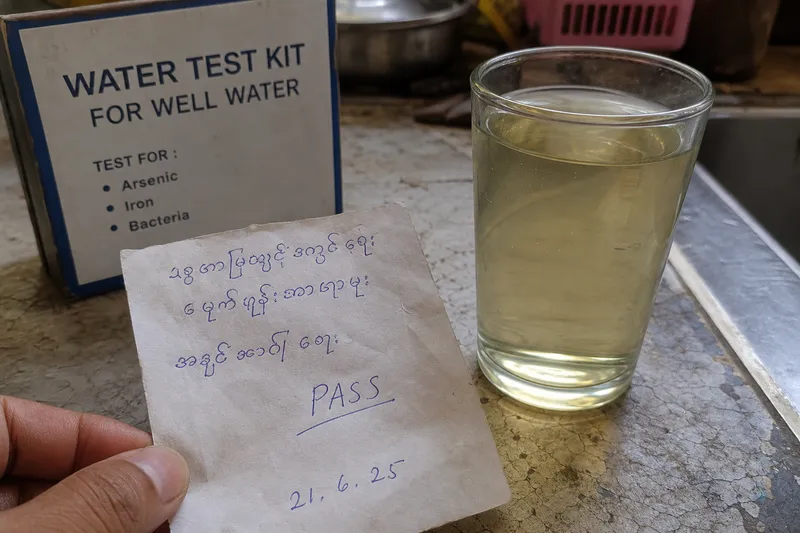
Picture a household near a delta township. Someone paid for a field kit or a lab slip. The result comes back with a word that feels final: pass.
What many owners never store in memory is the number and the standard behind that word. Public research on Ayeyarwady Delta wells has highlighted a hard pattern: a large share of tested wells can sit above the WHO 10 µg/L guideline while a smaller share sit above a national 50 µg/L style limit. University and news summaries of Myanmar well screening have also reported that a majority of sampled wells can exceed the WHO guideline in some analyses — which is exactly why “pass” without a named limit is incomplete.
So the calm is real. The completeness is not.
If you only remember the word and not the threshold, you have a label, not a finished water decision.
Two numbers. One unfinished job.
| Reference often discussed | Typical figure | What it means for a buyer | |---|---|---| | WHO guideline (arsenic) | 10 µg/L | Stricter health-oriented benchmark used in many global risk talks | | Myanmar national limit (commonly cited) | 50 µg/L | A well can be “within national limit” and still above WHO 10 |
That is the dual-standard trap:
- National “pass” ≠ automatic “matches the stricter guideline people saw online”
- WHO concern ≠ automatic proof that one Facebook RO ad is the correct next step
- No test at all ≠ a safe shortcut into machine shopping
AQUAPOLAR will not invent your well’s reading on this page. We will also not sell “medical-grade arsenic cure” language — that claim is a red line for honest dealers and for us.
Why delta families feel this first
Ayeyarwady Delta arsenic mapping and related groundwater reviews describe hotspots, regional variability, and the practical gap between testing and clear risk communication. Iron-rich wells are sometimes discussed alongside arsenic risk geography — useful as a conversation clue, never as a home diagnosis by colour alone.
If your household relies on a tube well, a shallow well, or a mixed tank/well setup after rain, treat arsenic as a test-first topic before you fall in love with a product photo. That order matters more than the colour of the housing on Facebook.
Yangon apartments on city supply are a different conversation — taste, pressure, peak demand, and install space still dominate — but families with delta roots, village wells, or new boreholes should not copy a friend’s city RO story and call it risk management.
What arsenic talk is not
- Not a substitute for TDS context when the real fight is dissolved solids anxiety
- Not a reason to skip peak demand when morning bottles already empty the jug
- Not permission for a seller to promise disease cure, “hospital-grade detox,” or guaranteed outlet arsenic from a screenshot
- Not a reason to ignore local support once any treatment path is installed
If a post uses fear of children + a countdown timer + an unverified “removes arsenic 99%” badge, leave. That is marketing theatre, not a water plan.
Test before you shop the model
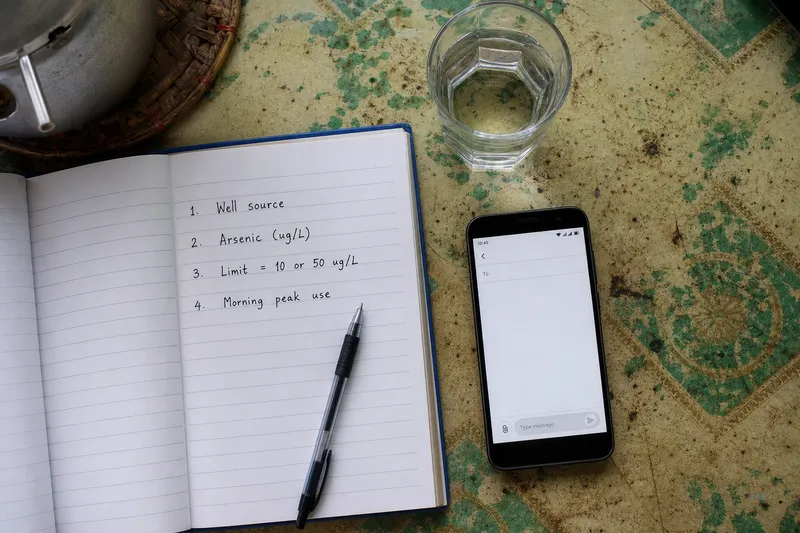
The buying order that protects wallets:
- Source honesty — well / city / tank / mixed; rain behaviour; nearby drainage if known
- Arsenic result with units — µg/L if available, plus date and who tested
- Which limit was used — ask explicitly: 10 or 50?
- Household demand — people, cooking share, morning rush
- Only then talk capacity class and install path
Shopping the model first is how households buy a pretty box that answers yesterday’s Facebook ad instead of this week’s water job.
New tube wells in delta areas deserve the same discipline: research and field practice keep urging continued testing and clearer owner communication precisely because wells keep being drilled faster than memory keeps results.
Paths after a result — without magic words
Depending on the reading, location, and household use, people discuss different paths: retest / deeper or alternate source / treatment process options / not using the well for drinking. Those are planning forks, not a single product slogan.
Reverse osmosis is one technology family people ask about in treatment conversations. It is not a medical device claim on this website, and 400GPD is a capacity-class name, not a certificate that your specific well outlet will meet any arsenic number.
If demand is real — drinking plus cooking, guests, bottle loads — then a class talk like RO Machine 400GPD can enter after the water picture is honest. Product page: RO_400GPD. Meaning of the class name: What 400GPD means.
How to talk about risk without panic theatre
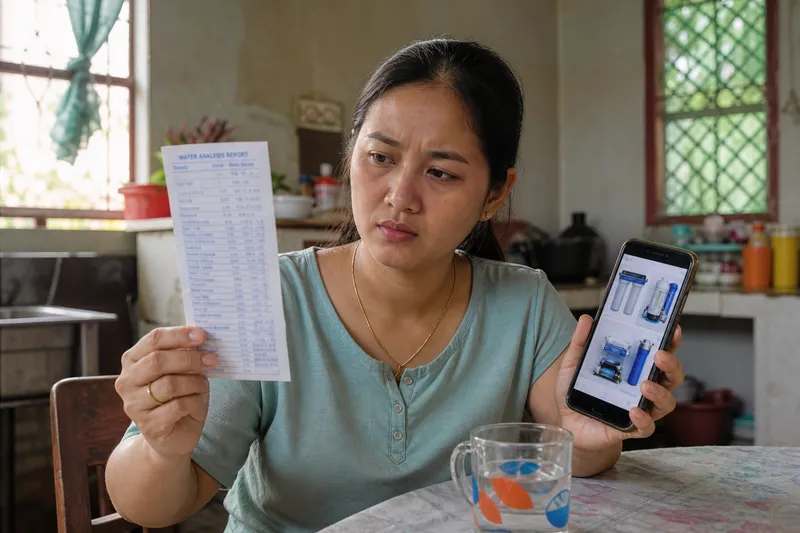
Parents ask sharper questions than ads deserve. Keep the tone firm and plain:
- Name the two limits so “pass” cannot hide which one was used
- Prefer a written result with date over a remembered word
- Separate drinking water planning from medical treatment promises
- Bring peak-hour reality into the same message so sizing does not get forgotten
Scare copy that invents disease timelines is as unhelpful as sellers who shrug “national pass, no problem.” The useful middle is a short, checkable brief.
Dealer and school note (same red line)
If you sell purifiers, or you manage water for a school compound with a shallow well, the compliance line is the same: do not promise medical-grade arsenic cure. Explain testing, limits, and system boundaries. Point families to a quote or showroom conversation when demand and source notes are ready — not when fear is hottest.
Schools weighing arsenic and microbial checks as a dual panel are asking a stronger question than “which Facebook RO looks nicest.” Keep both lists; do not collapse them into one sticker.
What to send AQUAPOLAR on Viber
- Township / village area (delta, Dry Zone, Mandalay, Yangon, other)
- Source type: tube well, shallow well, city, tank, mixed
- Arsenic result if you have it — number, units, date, 10 vs 50 if known
- Taste / iron staining / rain change notes (clues, not diagnoses)
- Peak morning jobs that need purified water
- Whether you want showroom talk or a written quote path
Viber 09668896889 · Get Quote · Showroom / Insein · Facebook Message on the AQUAPOLAR page
We do not need a perfect laboratory binder to start. We need an honest source picture so class advice is not guesswork.
Related guides
- Should you test TDS before home RO?
- 4 checks before buying RO in Yangon
- UV vs RO — what to ask
- Showroom vs Facebook-only buy
- Five questions before an RO quotation
Ready to replace “it passed” with a finished question?

Bring the limit, the number, and the morning rush into one conversation. That combination — not a lone “pass” — is how careful Myanmar well households talk about the next step.
Message on Viber, request a quote, or visit the Insein showroom with your test notes.
Related products
Next step
Request a quote, or use Viber for Myanmar local support.
More guides: Support guides