Support / Guides / Hot Season Peak Use — When Home RO Feels Too Slow
Hot season does not ask for your average.
Hot Season Peak Use — When Home RO Feels Too Slow
For: Myanmar homes whose RO feels short in hot months
Hot season in Yangon does not care about the quiet week you used to size your RO.
People drink more. Guests stay longer, asking for a cold glass instead of leaving after a short visit. Cooking and cold drinks stack in the same short evening window. The machine that “felt fine” in a mild month suddenly leaves everyone waiting on one jug, and nobody in the house can point to anything that actually broke.
This guide is about sizing for hot-season peak use, not for a soft average measured on a cool December evening.
The fix is not complicated once the real question is asked correctly — but almost nobody asks it before the heat arrives.
The April everyone remembers differently
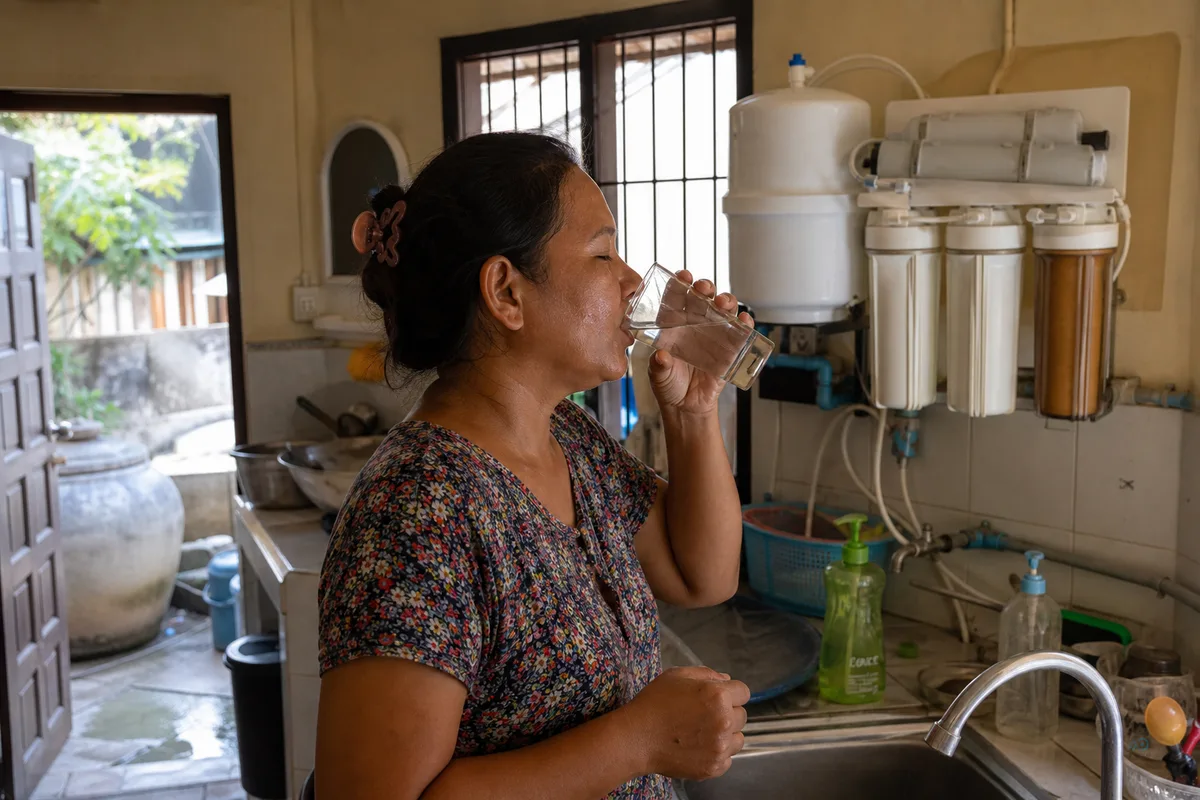
Every household that has lived through a full hot season in Yangon has a version of the same memory: the week the jug started running empty by mid-morning, weeks before anyone expected it. Parents remember it as “the machine got weaker.” The machine, of course, did nothing differently at all — it simply kept producing at the same rate it always had, while the household around it quietly doubled its demand.
That gap between what people remember and what actually happened is exactly why hot-season complaints get misdiagnosed as machine failures instead of what they usually are: a demand spike arriving right on schedule, every single year.
Once a household sees the pattern clearly, the sizing conversation stops being a mystery.
Heat raises demand — that is physiology and habit, not drama
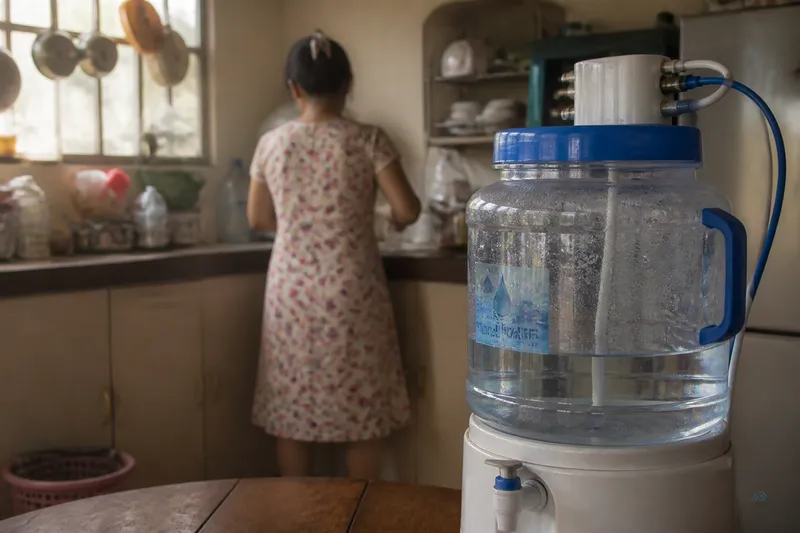
In hot weather, households naturally increase fluid intake and cold-drink preparation. Public-health heat guidance worldwide treats hydration as a core coping behaviour in high temperatures. You do not need a fake “litres per degree” chart on this page to recognise the kitchen pattern: more glasses, more often, in the same short windows as every other month of the year.
Pair that with Myanmar’s incomplete safely managed drinking-water coverage — about 60% of the population in 2024 on JMP-linked SDG 6 estimates (UN-Water / SDG 6 Data) — and you see why families already treat home purified water as critical infrastructure, not a lifestyle accessory. Hot season simply raises the stakes on a fight that was already ongoing.
Two rushes some homes forget
Hot season is not only 7–9am.
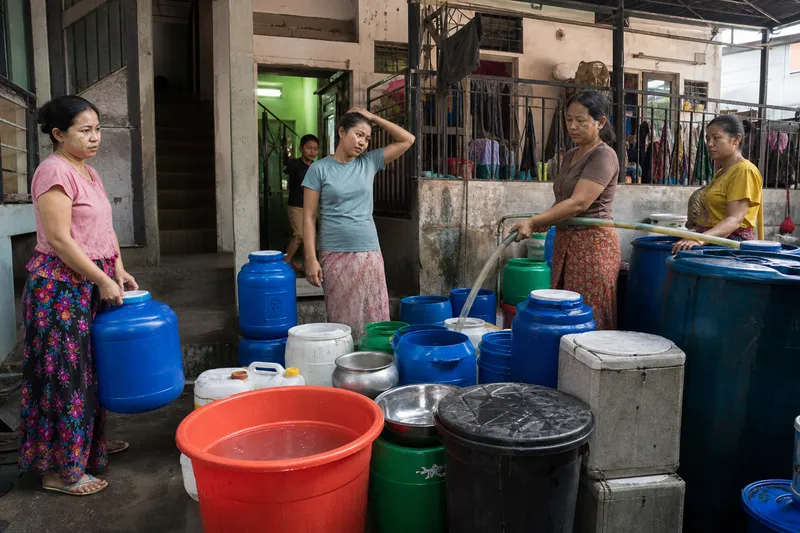
Many households get a second peak when everyone returns home in the late afternoon, cooks dinner, and pours cold drinks for the whole family in the same hour. If you sized only for “morning drinking,” the evening heat still empties you just as effectively — morning rush · hidden load.
Households that survive one rush comfortably often assume they are fine for the day, and are surprised all over again by the second one.
Two households, one heatwave, different outcomes
A family in Thanlyin buys their RO unit in November, during a calm week when nobody in the house is drinking much beyond the usual tea. The machine keeps up easily for five months straight, and everyone assumes the sizing decision was correct.
Then April arrives. The same household that felt comfortable in November is now filling water bottles for three children before school, making cold drinks for an elderly parent who feels the heat more than anyone else, and hosting relatives who stay longer in the cool of an air-conditioned room. The RO unit has not changed at all — but the household drawing from it has quietly become a different, thirstier household for four months of the year.
A neighbour two floors up bought the same machine but described their hottest week honestly before buying — including the elderly parent and the after-school bottle routine — and asked directly whether the class fit that specific week, not an average year. They are still comfortable in April.
Why quiet-month sizing fails
Buyers often decide after a calm week, usually in a cooler month:
- “We don’t use much.”
- “It worked fine in December.”
- “My friend’s smaller machine is fine for their house.” — friend-sizing
Then the hot months arrive. The sticker on the box did not grow. Your load did — including school bottles and guests when calendars overlap with the hottest weeks of the year — school-term · Thingyan / guests.
Power cuts and intermittent supply
Heat season often coincides with strained electricity and pumping schedules in apartment buildings, exactly when demand is highest. When roof tanks or boosters stutter under that combined load, an RO that needed stable feed pressure feels even slower than usual. That is an install and building-services question as much as a GPD sticker question — install checklist · low pressure · storage tank.
A household that blames the RO class alone, without checking whether pressure also dropped that week, often solves the wrong half of the problem — and pays for a bigger machine that still struggles on the same weak feed line.
What actually changes between a mild month and a hot one
It helps to name the specific things that grow in hot season, rather than treating "more water" as a vague feeling:
- Drinking frequency per person, especially for children and elderly household members
- Cold-drink preparation, which did not exist as a category in cooler months
- Guest visits, which tend to last longer in an air-conditioned or fan-cooled room
- Bottled-water backup purchases, which quietly signal that the RO already fell behind
Naming these four separately, rather than lumping them into "we use more water in summer," is what turns a vague complaint into a sizing conversation a technician can actually act on.
A one-line note for each of the four, sent before your first message, saves several rounds of back-and-forth questions later.
When RO Machine 400GPD-class enters
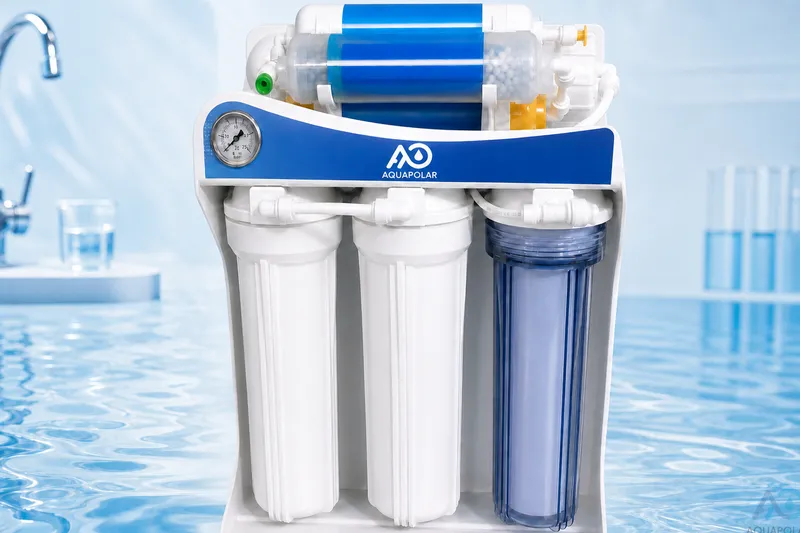
Discuss RO Machine 400GPD as a capacity class name — not a daily gallon promise — when:
- Hot-season mornings or evenings already create waiting on a predictable schedule
- Purified water covers drinking and cooking, not drinking alone
- Guests or a growing household make mild-month sizing feel obsolete
- You want Yangon-local next steps — Viber, quote, or a showroom visit
Product: RO_400GPD · what 400GPD means · who it fits.
Do not panic-buy the cheapest sticker in a heatwave
Heat makes people rush a decision. Rush makes price-only mistakes far more likely, because a hot, thirsty household wants a fix today, not a considered brief next week. Confirm local support and parts before committing: local vs one-time · spare parts · ready stock.
A machine bought in a panic during the hottest week of the year is rarely the same machine a calm household would have chosen with a full brief. The best time to have this conversation is a month before the heat arrives, not the week it peaks.
Marking a reminder for a month before last year's worst week costs nothing and buys back the calm brief that panic buying always skips.
The cost of waiting until the hottest week to act
Households that wait until the hottest week of the year to address a sizing problem tend to make three compounding mistakes at once: they buy under time pressure, they compare only price because there is no time for a proper brief, and they skip questions about pressure and space because the jug is empty right now and patience has run out.
Any one of those mistakes alone is recoverable. All three together usually produce a machine that solves this week's emergency and creates next year's regret, because the underlying peak-demand numbers were never actually discussed.
The households that avoid this outcome are not the ones with the biggest budget — they are the ones who asked the peak-demand question a few weeks earlier than everyone else.
Three questions before you buy in heat

- When does water feel short in hot months — morning, evening, or both windows?
- What stacks in that hour — drinking, cooking, cold drinks, guests?
- What already fails every hot season, even before this year's heat arrived?
Viber 09668896889 · Get Quote — RO_400GPD · Showroom prep
Related
- Rainy season taste/smell
- Outgrew small under-sink
- Hidden home water load
- Low pressure homes — RO sizing
- FAQ
Ready for the hot hours — not the mild average?

Describe the hottest week's rushes, both morning and evening. Then ask whether 400GPD-class belongs in the conversation — claim-safe and local, not a guess made in December weather.
A ten-minute message today can save an entire hot season of arguments about who fills the jug first.
Message on Viber, request a quote, or visit the showroom before the next heatwave arrives.
Related products
Next step
Request a quote, or use Viber for Myanmar local support.
More guides: Support guides