Support / Guides / Signs You Outgrew a Small Under-Sink RO
The cabinet did not grow. The morning did.
Signs You Outgrew a Small Under-Sink RO
For: Myanmar homes whose small under-sink RO no longer keeps up
The cabinet did not grow.
The morning did — more bottles, more cooking, more people, hotter months, more guests dropping by on a Sunday.
Nobody announces the day a small RO stops being enough. It happens in small increments, most of them easy to explain away one at a time, until a household is quietly running on bottled water and blaming "low pressure" for a problem that is really about how much the family has grown since the unit went in.
This guide lists clear signs you outgrew a small under-sink RO in Myanmar, and how to open a claim-safe class conversation without panic — because outgrowing a machine is a scheduling problem, not a personal failure.
Homes outgrow machines when demand becomes “available when needed”
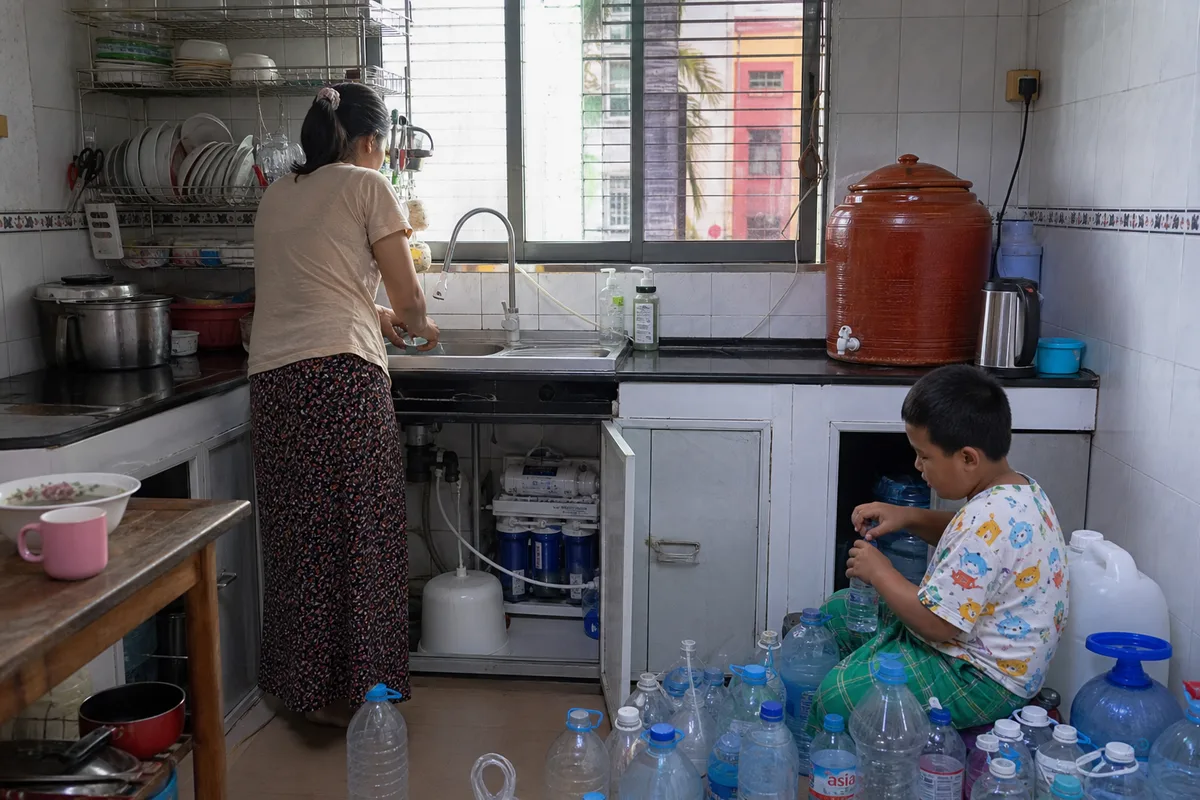
WHO/UNICEF JMP defines safely managed drinking water partly by whether water is available when households need it — not just whether a filter exists somewhere under the sink. A small under-sink pattern that worked for a quieter household fails that exact test at 7am: water technically exists in the system story, but not in the jug when everyone reaches for it in the same five minutes.
Against Myanmar's roughly 60% safely managed drinking water coverage estimate for 2024 (SDG 6 Data / UN-Water), families already treat home water as something to manage carefully, not something to take for granted. Outgrowing a small RO inside that reality is ordinary life, not a moral failure and not a sign anyone bought the wrong thing three years ago.
The unit that felt perfect on moving day
Picture the day it was installed. Maybe it was a newlywed couple's first real appliance purchase, chosen carefully after comparing two Facebook sellers. Maybe it was a small family moving into their first Yangon apartment, proud that the kitchen finally had "clean water built in" instead of jugs carried up from the corner shop. The unit fit the cabinet. It fit the budget. On a quiet evening, one glass at a time, it worked exactly as promised, and nobody thought about it again for a long while.
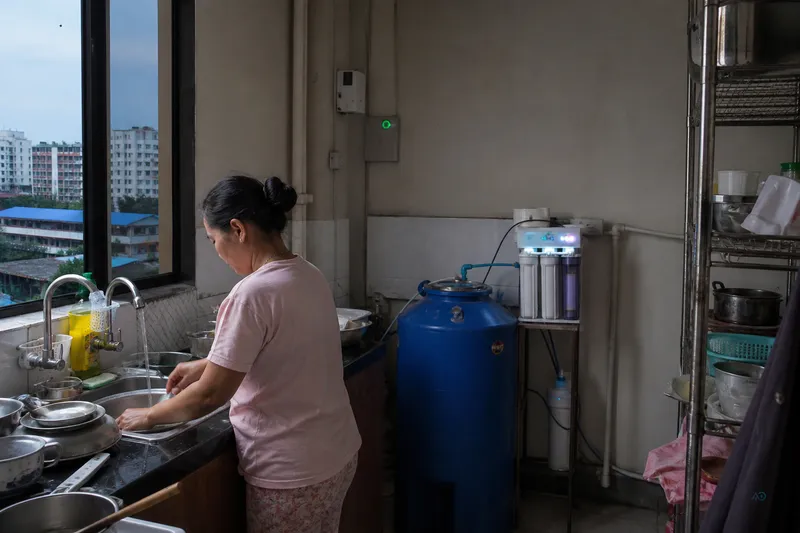
Nobody buys a small under-sink RO expecting to outgrow it. They buy it expecting the household to stay roughly the same — and households rarely do. A second child arrives. A parent moves in for the school term. A helper starts cooking daily instead of twice a week. None of these changes announce themselves as a "sizing problem." They just quietly add draws to the same small tank, morning after morning, until the machine that felt perfect on day one starts to feel undersized by year three.
Three years later, the same machine, a different household
The unit itself has not changed. Its tank is the same size it was on installation day, its flow rate is the same number printed on the same sticker. What changed is everything around it: two children now old enough to carry their own bottles to school, a grandmother visiting most weekends, a helper who now cooks lunch and dinner rather than just dinner. The household quietly became a bigger job than the one the machine was ever asked to do.
This is why "the machine must be getting old" is often the wrong diagnosis. A three-year-old RO unit in daily use is not ancient. What aged faster than the hardware was the fit between the machine's capacity and the household's real daily draw — and that mismatch has nothing to do with wear and everything to do with growth nobody sat down to measure.
Ask most families when the trouble actually started and they will not point to a repair date. They will point to a season — the year the second child started school, the year a parent moved in permanently, the year guests started arriving almost every weekend. The machine's calendar and the household's calendar simply stopped matching, and nobody noticed until the mornings started to hurt.
Six signs the small pattern already lost
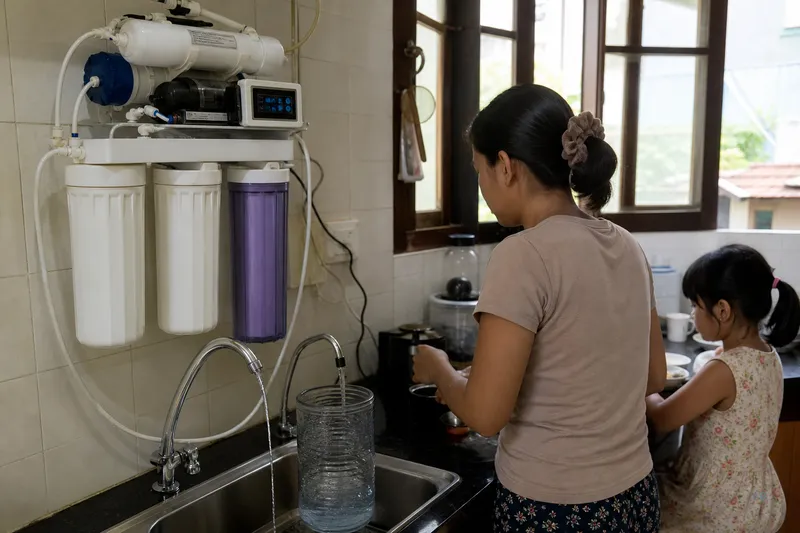
The signs rarely arrive as one dramatic failure. They arrive as small, repeated frustrations that a household starts explaining away instead of naming out loud:
- Every busy morning ends in someone waiting for the jug to refill
- Bottled water became the quiet backup nobody planned to buy
- Guests expose the machine immediately — Thingyan / guests
- School-term bottles overwhelm the jug before the gate even opens — school-term
- Hot-season evenings add a second daily failure on top of the morning one — hot season
- You keep saying "it was fine when we moved in" as if the machine changed, instead of the household
Any one of these alone is a minor annoyance. Three or four together, most weeks, is a household that already outgrew its machine and has not yet said so out loud.
Also read: home RO no longer enough · hidden load · morning rush.
The quiet denial before the admission
Most households do not decide to outgrow their RO in one conversation. They drift into it through small excuses: "the pressure must be low today," "maybe the filter is just due," "let's just buy a few bottles for this week only." Each excuse is individually reasonable. Stacked over months, they become a pattern of denial that delays the real question — not "what is wrong with the machine," but "has our household simply become a different job than the one this machine was sized for."
The admission usually arrives quietly too, often triggered by one bad morning rather than a sudden realisation: a guest week, an exam season with more bottles than usual, or a hot spell that pushes drinking demand past what the small tank can recover between draws. That single bad week is not the cause. It is only the moment the existing gap finally becomes impossible to ignore.
What staying quiet actually costs
Delaying the admission rarely saves money. It usually just moves the cost somewhere less visible:
- Weeks or months of bottled-water spending that quietly outpaces what a class upgrade would have cost
- Morning arguments that have nothing to do with the water itself and everything to do with everyone being rushed and thirsty at once
- A guest week that becomes embarrassing instead of comfortable, right when hospitality matters most
- An eventual panic upgrade, chosen under stress after the old unit finally gives out completely, instead of a calm decision made on your own timeline
None of these costs are dramatic on their own. Together, over a year, they usually add up to more than the price difference between the small unit and the next class up.
Rain weeks can unmask an undersized install
Monsoon taste and smell shifts make people stare hard at the machine, wondering if something inside has failed — rainy season. WHO's *Guidelines for Drinking-water Quality* note that aesthetic issues — taste, odour, appearance — often drive households to question a water source even when the underlying supply is otherwise fine. Sometimes the real issue behind a rainy-season complaint is simply an overdue filter. Sometimes the real issue is that peak volume was already too high for months, and the rain only added an emotional trigger on top of an existing capacity problem. Separate service concerns from class concerns before assuming either one alone explains everything — filter fear.
Mistakes that keep the small unit in place too long
A few habits quietly extend the outgrown period longer than it needs to last:
- Blaming the machine's age instead of asking whether the household's daily draw actually changed
- Replacing a failing unit with an identical model, without re-asking the peak-demand question first
- Waiting for "one more busy season" to pass before admitting the pattern already failed
- Assuming a technician's repair visit will fix what is really a capacity mismatch, not a service fault
Naming the real question — has our household outgrown this machine — protects a family from repeating the same small purchase for another three years.
None of these habits are dishonest. They are simply the easiest thing to believe when admitting a sizing mistake feels harder than buying one more case of bottled water for the week.
Before you upsize: install and pressure still matter
A bigger sticker dropped into an impossible cabinet is still a failed upgrade. Before any class conversation goes further, confirm the physical facts a bigger unit will actually need:
- Install checklist — space, drain, and power realities
- Storage tank with bigger ro class — where a larger tank will actually sit
- Low pressure — whether feed pressure can support the next class at all
Shop kitchens with genuine commercial peak may need commercial framing instead of a bigger home unit — commercial when home class fails.
When RO Machine 400GPD-class enters

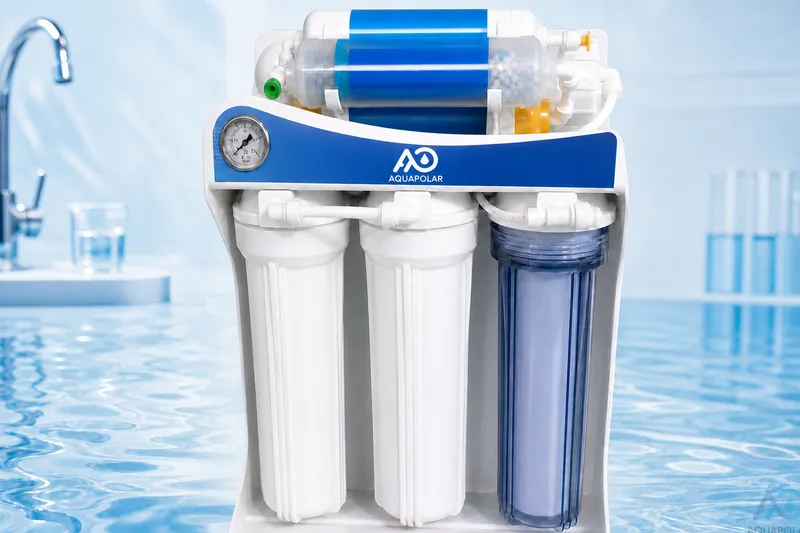
Discuss RO Machine 400GPD as a capacity class name — not a daily gallon guarantee for your specific kitchen — once peak drinking and cooking demand has already broken the small under-sink pattern, and the space, drain, and pressure facts above can actually support the conversation.
Fit: who 400GPD-class fits · what 400GPD means · RO_400GPD.
Avoid the shortcuts that replace this brief with a guess — friend-sizing · price-only · emergency buy.
What to send on Viber
A short, honest message moves this faster than a long apology for "still using the old one":
- What fails now — waiting, taste, or a full bottled-water switch
- Peak times — morning, evening, or both
- Photos of the current under-sink setup and cabinet space
- Township
- "Small under-sink no longer enough — advise class fit."
Viber 09668896889 · Get Quote · Showroom · Spare parts
Related
Ready to admit the morning changed?

Name the signs. Measure the space. Then size the next class on a Yangon-reachable path — claim-safe, not ashamed, and not one more month of pretending the old cabinet still fits the new household.
The small unit did nothing wrong. It just finished the job it was originally sized for, faster than anyone expected.
Message on Viber, request a quote, or visit the showroom path.
Related products
Next step
Ready to talk through fit for your home or site? Message on Viber or request a quote.
More guides: Support guides